
Is Your Emotional Rollercoaster Making You Miss?
When you judge long-term change by short-term feelings, your quiet progress gets buried. Tracking is how you start seeing it again.


The problem is not always effort. Sometimes it is evidence of progress.
Most people do not quit because they are lazy. They quit because they cannot see enough proof that their work is actually doing anything.
The beginning usually feels clear because the pain is obvious. You know exactly what you want to change. You know what has not been working. You can feel the gap between where you are and where you want to be. There is a deep desire to change. So you start. You make a plan. You promise yourself this time will be different. For a few days, maybe even a few weeks, the effort itself feels like progress.
Then the emotional high wears off.
The goal is still far away. The work has now become repetitive. The results are not dramatic enough to keep your attention. You are doing better, but not enough that it feels obvious. That is the point where the mind starts looking for evidence, and if you have not been tracking anything, it usually looks in the least reliable place possible: your in-the-moment emotions.
That is where a lot of people lose their drive. They are not actually failing, but they feel like they are. Measuring long-term progress with short-term emotions causes a feeling of stagnant emptiness. Because they cannot see their progress slowly building upon itself, a sense of failure starts creeping in.
Progress usually disappears into ordinary days
Your progress is often invisible while it is happening. It hides inside ordinary days. It hides inside the walk you almost skipped. It hides inside the meal that was not perfect but was better than the old pattern. The page you wrote is moving towards your end goal, even though the book still feels unfinished. It hides inside the calmer response, the better decision, and small adjustments. The moment when you noticed that your old habit is no longer running the whole show.
None of those moments feels like a transformation by itself. That is the problem. A single better choice rarely feels big enough to count. By themself each small step forward does not seem to matter much. Tracking this series of better choices will start to tell your brain a different story.
That is why tracking matters. While the process might seem tedious and unnecessary, it gives your brain the dopamine needed to keep you moving forward.
Tracking gives your brain something more reliable than a feeling
Tracking is not just about numbers. It is not about turning your life into a spreadsheet so you can judge yourself more efficiently. Used the right way, tracking is how you make the invisible parts of progress visible enough for your brain to recognize them. It gives you something more stable than mood, memory, or the story you happen to be telling yourself on a hard day.
Before you track something, your progress mostly lives as an impression. You think you are doing better, or you think you are doing worse, but you do not really know. Your thought at the moment creates an emotional view of your current progress. This can emotionally cloud out the real results. You remember the last few days more clearly than the last few weeks. You remember the mistake louder than the quiet consistency. The moment you slipped becomes more visible to you than the five moments where you did not. The mind is not neutral. It is often unfair in how it edits the actual progress.
Tracking gives you the clear, unedited version.
That does not mean the numbers tell the whole truth. They do not. But they give you a place to start. They give you a record you can compare against the feeling. When you feel like nothing is working, the record can show whether that is true or whether you are just tired. When you feel like you ruined everything, the record can show whether you actually broke the pattern or simply had one bad day inside a better trend. Tracking allows you to see trends and correct them if needed before that one bad day emotionally spirals into failure.
That distinction matters because most people do not need more shame. They need better feedback. They need to see that the small, often unnoticed routine steps are actually making progress towards their goals. Tracking allows you to take a step back from the emotions your day has brought on so that you can see the actual work you have done over time.
A vague goal can disappoint you. A tracked system can teach you.
A vague goal can only inspire you or disappoint you. A tracked system can teach you. That is the shift you can keep coming back to. When the goal is vague, every setback feels personal. If you say, “I want to get healthier,” but you do not know what healthier means, your progress ends up being decided by how you feel about your health. Every hard day becomes evidence that you are not doing enough.
If you say, “I want to write more,” but you do not track the daily writing process, the unfinished book can make every day feel like an unattainable failure. If you say, “I want to fix my finances,” but you do not track your money, then the stress becomes the only measurement. Bills can cause a negative emotional view, even when they are getting paid.
Tracking turns the goal into something you can actually work with. It asks better questions.
What am I measuring?
What is changing?
What is staying the same?
Where does the plan keep breaking down?
What time of day is hardest?
What part of the process keeps creating friction?
Asking these questions allows you to see actual progress. It then allows you to see what is working that you would not have noticed if I were only judging by how you felt about it. This allows you to see whether your progress is going in the right direction or whether it may be time to start making small changes to get you back on track. Those questions are more useful than “Why can’t I just get it together?”

The point is not to blame yourself. The point is to find the weak spot.
That is one of the biggest benefits of tracking. It moves you from emotional self-attack to system analysis. Instead of your negative thoughts making you the problem, you can look at the process through your tracked data. Maybe the plan was too strict. Maybe the goal was too large for the season of life you are in. The routine was working until the schedule changed. The food plan you were keeping track of worked until the afternoon crash, and then you started to binge.
Maybe the writing routine worked until you tried changing it to the wrong time of day for your brain. Maybe the budget worked on paper, but it ignored one predictable expense that shows up every month. No matter how much your budget works, it is going to start you in the hole if you are not planning to pay rent at the end of the month rather than at the beginning of the next month when it is due.
When you are not tracking, all of that gets blurred together. The only thing you are left with is the feeling that you failed again. When you are tracking, you can begin to see the actual (often smaller) failure point. That gives you something to adjust. There is a huge difference between “I failed” and “this part of the system failed.”
Your progress is not a failure; it just needs an adjustment to keep it going in the right direction. The first one creates shame. The second one creates information. While your emotions will show you the first, it rarely shows you the details behind the second. Information is where real progress starts to become possible. Tracking it allows you to see your actual progression and where you need small corrections, not over-reaching feelings of failure.
What you track is what your brain starts watching
The other thing tracking does is train your attention. Once you start measuring something, your brain begins to treat it as important. If you track your steps, you start noticing chances to walk. If you track what you eat, you start noticing patterns in your hunger, energy, and decisions. If you track your writing, you start noticing when your ideas are clearest and when you are just forcing words onto the page. If you track your spending, you start noticing the little leaks that used to disappear into the background.
That is not magic. It is your brain focusing your attention towards your goal, and learning to ignore the immediate emotions. This starts to happen because the details that you are tracking start to show how your emotions may not be telling you the real truth behind your progress. Your mind now has the ability to stop thinking emotionally and start processing rationally.
Your brain is always scanning for something. The question is whether it is scanning for vague threats and reasons to quit, or whether it is scanning for useful information. Tracking gives it a target. It tells the brain, “This matters. Watch this.” Over time, your mind starts helping you gather evidence around the goal instead of only reacting emotionally to the moment.
That is when the process begins to change.
Tracking does not do the work. It helps you understand the work.
No matter how much tracking you do, it will not actually do the work for you. You still have to take the walk, write the page, make a better decision, send the message, pay the bill, cook the food, or sit with the uncomfortable emotion instead of letting it run the whole day. Tracking does not replace effort. It makes your effort towards your goal easier to understand.
That understanding is important because effort without feedback is exhausting.
If you keep working but cannot see what the work is doing, your brain starts asking why you are bothering. That is especially true when you are chasing a big goal. Losing a lot of weight, rebuilding finances, writing a book, or changing family patterns can become a long process. Managing ADHD, healing emotionally, or building a new life direction does not happen in one dramatic scene. It happens through daily repetition. It happens through enough small decisions that eventually create a pattern which brings you closer to success.
But if you wait until the pattern is undeniable before you give yourself credit, you may quit before you ever see it. Tracking helps you see the pattern earlier. It lets you respect the small steps while they are still small. You stop focusing on a single walk and start seeing how it becomes part of a weekly trend. You start to see that paragraph becoming part of a completed chapter.
All of a sudden, you start creating a calmer conversation, which becomes part of a different way of responding. Your better food choice becomes part of understanding your body instead of fighting a craving that eventually turns into a binge. This allows you to look for healthier options that can help satisfy that specific craving. Tracking gives you the ability to see the trend, find where the problem starts, and make an adjustment that will redirect you so that you avoid a setback your consistantly having.
Your ability to make this change allows you to adjust a meal plan that works on paper into a progressive system that focuses on exactly what your body (and your mind) actually needs. Rather than trying to avoid your feelings, it allows you to address them. This can eventually avoid the feeling of bingeing altogether. Ultimately, you start realizing that a single day does not have to prove everything because it belongs to a larger trend. That trend is one that you have the ability to redirect when needed.
This is where tracking can become motivating. I am not referring to the shallow way people usually talk about motivation after watching a YouTube video. It is not about getting hyped up for the moment. It is about having enough visibility for you to use your motivation to continue toward your end goal. This is the practical kind of motivation that comes from being able to look back and say, “Something is happening here.” That kind of motivation is often a bit quieter, but it is stronger.
Feedback is useful. Self-punishment is not.
Of course, tracking can go wrong. Anything useful can become unhealthy when it gets turned into punishment. Tracking, when managed incorrectly, can become another way to shame yourself. The scale can become a result of failure. The budget can become a source of panic, rather than motivation to increase your income. The productivity tracker can become proof that you are never doing enough. Numbers can emotionally start running the person instead of driving them towards their end goal.
That is not the version I am talking about.
Good tracking should make you more informed, not more anxious. It should help you make better decisions, not turn every day into a final exam. It should reveal patterns, not reduce your entire life to a single, momentary score. The point is not to obey the numbers, it is to see the progressive trends. Your goal is to understand what the numbers are showing you and then use that information with judgment to continue or make slight adjustments.
That distinction matters because the right kind of tracking gives you more compassion, not less. It lets you see that a hard day is not always a collapse. Sometimes it is just a simple data point in a larger trend. By noticing it, you can see that the plan may need a slight change instead of assuming you are a broken system. It lets you notice effort that your emotions would have erased. You are able to start building trust with yourself slowly, because now you can see that you are doing more than your worst moments emotionally suggest.
That is the part I find most useful.
Tracking gives you proof when your feelings are loud. It allows you to see what you may have been missing in the moment by allowing you to step back and see the larger picture. The data you collect can now show you what your powerful emotions cannot.
A feeling can be real without being the whole record
Don’t get me wrong, your feelings are real. They definitely matter. They are information that needs to be accounted for. But they are not always accurate records. I can feel behind and still be moving forward. I can feel stuck and still be building consistency. I can feel like nothing is changing and still be laying the foundation for a major shift. If everything only lives in my head, I am more likely to believe that momentary feeling over the developing pattern.
This is where tracking gives that pattern a voice. It gives me a way to ask, “Is this emotion I am feeling true, or is this just today?” That question can keep a person from quitting. It can change failure into a short diversion that can be corrected to continue your progress.
Sometimes the thing that looks like failure up close actually shows progress when you zoom out. The bad day is real, but so is the better week. The missed step is real, but so is the longer trend. The unfinished project is real, but so are the pages that did not exist before. The emotional setback is definitely a real thing, but it does not need to cloud your vision from the fact that you noticed it faster than you used to. This gives you the ability to make a change instead of spiraling emotionally.
That is the kind of progress people miss when they are not tracking. It is the quiet evidence that pushed you forward one more day, when things turned difficult. They miss the small recovery that could have led them to the progress they could have had. They miss the fact that the plan is not dead. It just needs an adjustment.
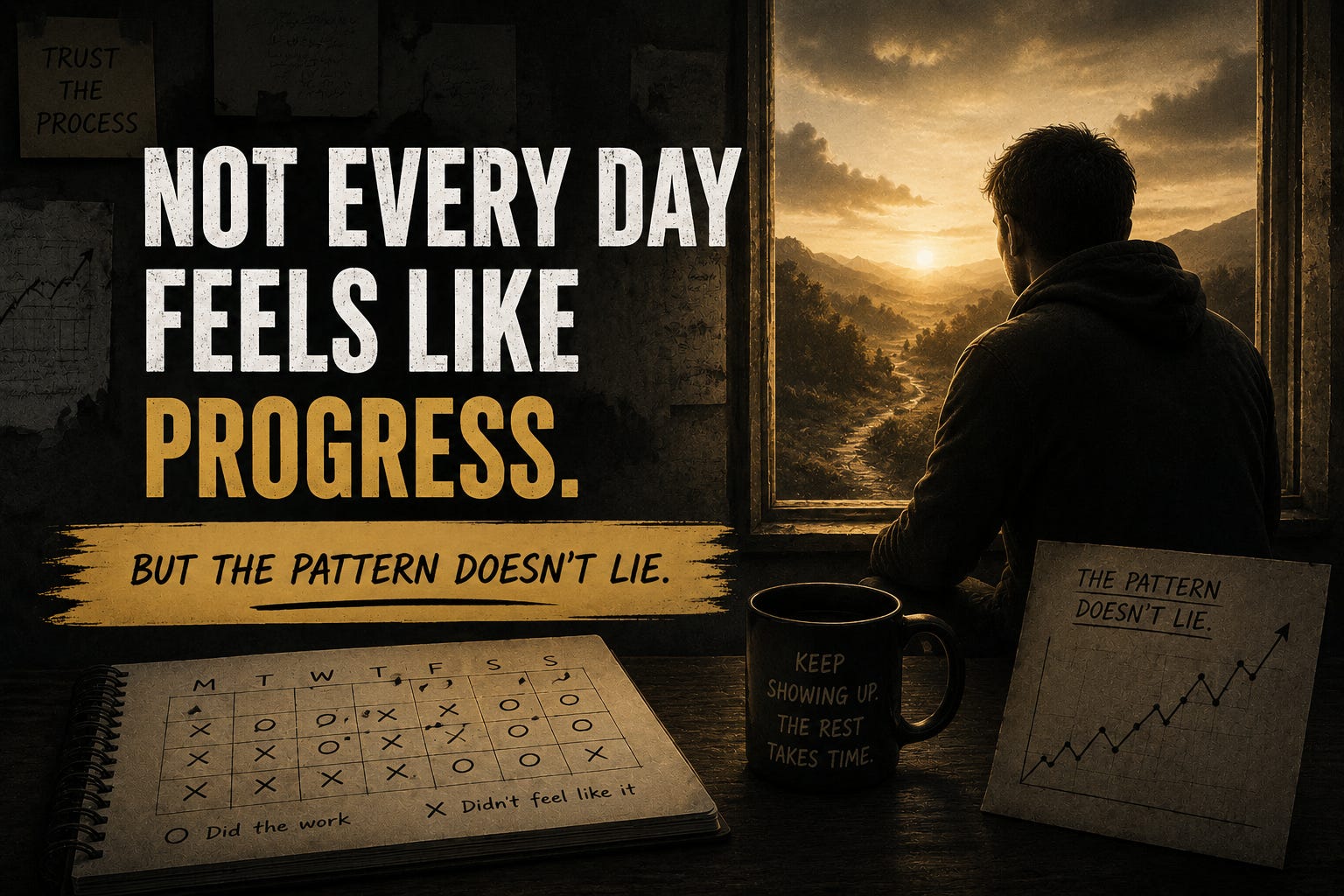
The real win is being able to see what is actually changing
So when I say you never really see progress until you start tracking it, I do not mean that life should become a collection of charts and checkboxes. I mean that progress needs to stay visible to you even when your emotions are focused on the moment. The brain needs evidence that you can provide with a system producing feedback. The person doing the work needs some way to know that the work is not disappearing into the air.
That is what tracking gives you.
It gives you something to study instead of something to guess about. Tracking gives you a way to find weak spots without turning yourself into the weak spot. It gives you small steps to focus on when the larger goal feels too far away. Your brain starts to learn that it has a job to do: look for the pattern, understand the pattern, and help improve the pattern. This will give you the ability to look past your momentary emotions and see the path you're taking towards completing your goal.
By the end of your journey, that may become the real lesson. Tracking may allow your brain to start focusing on success patterns instead of momentary emotions. You may start learning to see “the how” behind the goal. You may start looking for the steps towards success, rather than the momentary setback that gets viewed as failure.
Tracking is how you start collecting the proof
Progress does not always feel like progress while it is happening. Sometimes it feels boring or slow. Other times it feels like repeating the same small action with no guarantee that it will matter. However, when you track it, those small actions stop disappearing. They become evidence. That evidence matters because it gives your brain something better to work with than fear, frustration, or guesswork.
It gives you a record of movement. You can start to see a clearer next step. Tracking gives you a reason to keep going before the final result has arrived. Most people do not quit because they are lazy. They quit because they cannot see enough proof that the work is doing anything.
Tracking is how you start collecting the proof.
Question for you: What goals are you working on that tracking could make the process easier to follow?