
Connection First, Protection Second
Why Trauma Changes How We Experience Boundaries, Vulnerability, and Assertiveness


Have you ever noticed your body reacting to a conversation before your mind even understands why? Your body seems to feel something off, possibly dangerous, that you are not seeing. You want to actively participate in the conversation, but your body keeps tightening up on you and not allowing you to speak. You might even start to ask yourself what’s wrong with me?
Why can’t I do this?
This could indicate that your relational regulation may be out of balance. For communication to be effective, we must have three things aligned before we feel comfortable moving forward with any conversation: interpersonal boundaries, vulnerability, and assertiveness. Without this balance, we will not be able to react to normal interactions in a healthy and productive way.
I have been thinking a lot lately about what emotional health actually looks like in real life. Not the polished social media version of it, where every quote sounds profound, and every breakthrough fits neatly into a thirty-second clip. I mean the kind of emotional health that shows up quietly in everyday moments. The kind you feel when someone raises their voice at you, and your entire body shifts before your mind has even processed the conversation. The kind you notice when someone gets emotionally close, and part of you softens while another part immediately wants to pull away.
Do You Have Hard or Soft Emotions?
Growing up, I had to deal with a lot of traumatic events caused by racism. I quickly learned not to let things bother me, trust no one, and handle things for myself. The world I lived in made me emotionally hard and closed off to most people. I viewed emotionally soft people as weak and vulnerable. To me, they seemed controlled by their emotions. This was not a luxury I had the ability to have.
Now that I have become an adult, I have noticed that this one-sided view is, unfortunately, very common in society. Depending on the environment, individuals will usually get praised or criticized based upon if they are emotionally hard or soft. But the more I have studied trauma, attachment theory, neuroscience, and emotional regulation, the more I think both views miss something important. We tend to overlook whether the person is actually emotionally healthy.
What is Emotional Health?
Emotional health is not about becoming softer or tougher. Those are just surface-level expressions with something much deeper happening underneath. Instead, it is the ability to balance connections, protection, and self-expression without becoming overwhelmed. It is not reacting to an emotion in the moment but rather understanding that the surface-level feeling is part of a larger system.
James J Gross, a professor of Psychology at Stanford, put it this way. In his Process Model of Emotion Regulation, emotions are not just things that happen to us. They unfold through a process over time. We have the opportunity to regulate them multiple times throughout the process, not simply at the moment we recognize the emotions. Most of us only notice the opportunity when our emotions hit the surface. Gross points out that we have the opportunity to regulate or react to emotions by changing who we interact with, the situation, environment, and how we perceive others’ actions.
We tend only to see the opportunity when we have to respond. Some people become emotionally soft because their nervous system has learned that connection requires self-sacrifice. Others become emotionally hard because their nervous system has learned over time that vulnerability carries danger. I fell into the second camp.
Both are still adaptations.
Each is still an attempt at safety in an effort to protect the individual. They are outward expressions of something deeper within. For us to adapt to everyday life healthily and productively, we must become relationally regulated closer to the beginning of this time process, not at the very end. For this to happen, we must find an internal balance between our interpersonal boundaries, vulnerability, and assertiveness. When this is properly in balance, connection, protection, and self-expression can all exist together without constantly fighting each other inside of us.
Integrated Relational Regulation
Over the last few days, I have been working through a framework in my head that I keep coming back to. I started calling it Integrated Relational Regulation because it seems to describe the balance the nervous system is constantly trying to maintain between connection, protection, and self-expression.
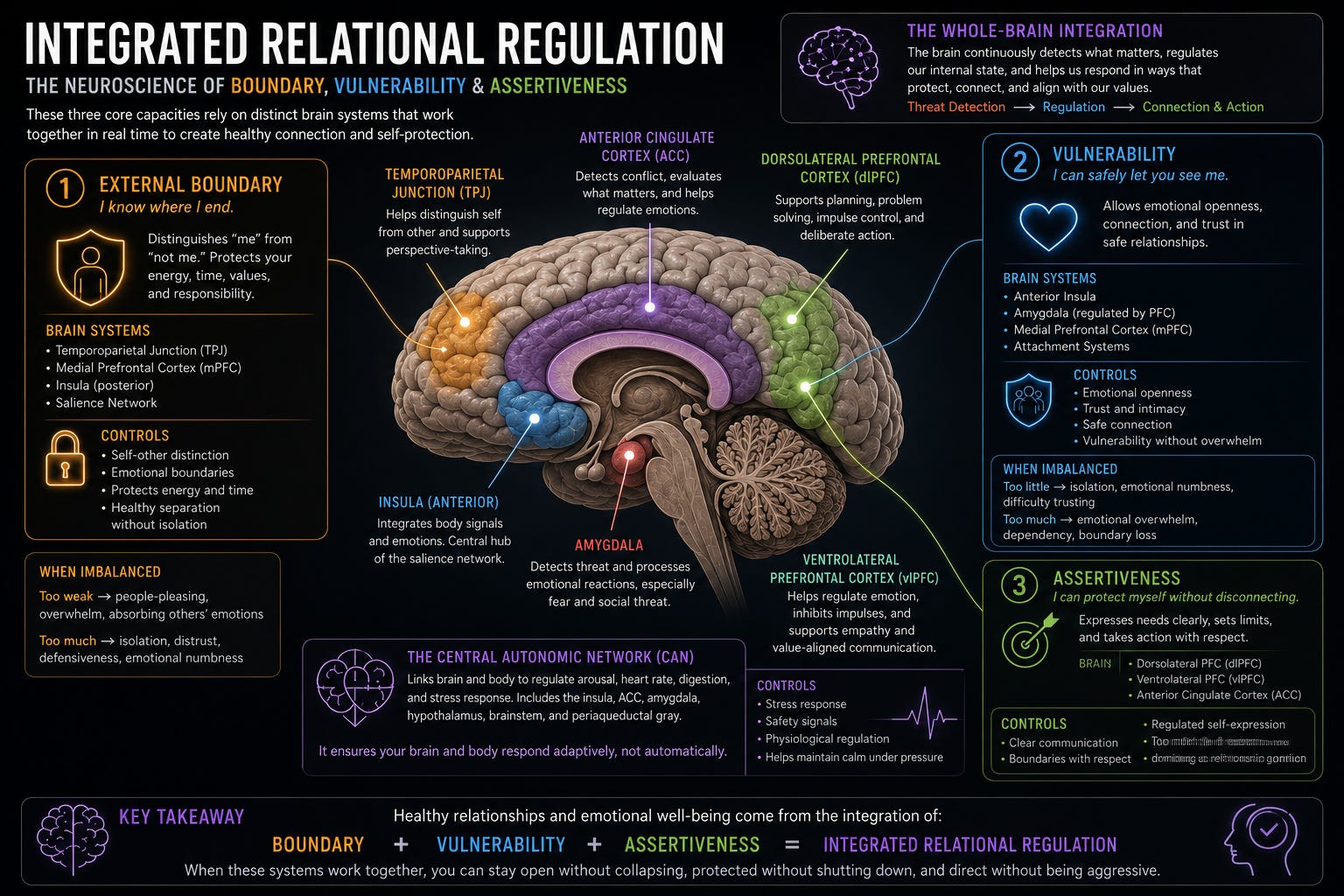
At its core, the idea is actually pretty simple. A healthy nervous system appears to rely on three systems working together at the same time: interpersonal boundaries, emotional vulnerability, and assertiveness. When those systems are integrated, a person can stay emotionally open without collapsing into someone else, protect themselves without emotionally shutting down, and express themselves honestly without becoming aggressive or disappearing entirely.
Unfortunately, trauma changes how those systems work together. Not because the person is weak, irrational, or broken, but because the nervous system adapts. When a person waits to regulate their emotions until they boil over to the surface, it becomes overwhelming. The body chooses to prioritize safety over connection.
Instead of the brain processing this in a normal, regulated way, different parts of the brain are activated, causing the perception to change. These locational changes (as shown in the picture below) cause the brain to take rational thought and turn it into an emotional experience. When you are dealing with trauma-based thought processing in your response, the physical location within your brain matters more than most people realize.
A regulated brain processes emotional situations very differently from a trauma-adapted brain. In the regulated brain shown on the left side of the image, the prefrontal systems remain active and connected. Areas responsible for self-reflection, emotional regulation, self-other distinction, empathy, planning, and communication continue working together in real time. The amygdala, which acts as part of the brain’s threat detection system, stays calm enough for the person to separate discomfort from actual danger. That allows the nervous system to stay open, curious, and emotionally connected. It is capable of creating healthy boundaries, vulnerability, and assertiveness at the same time.
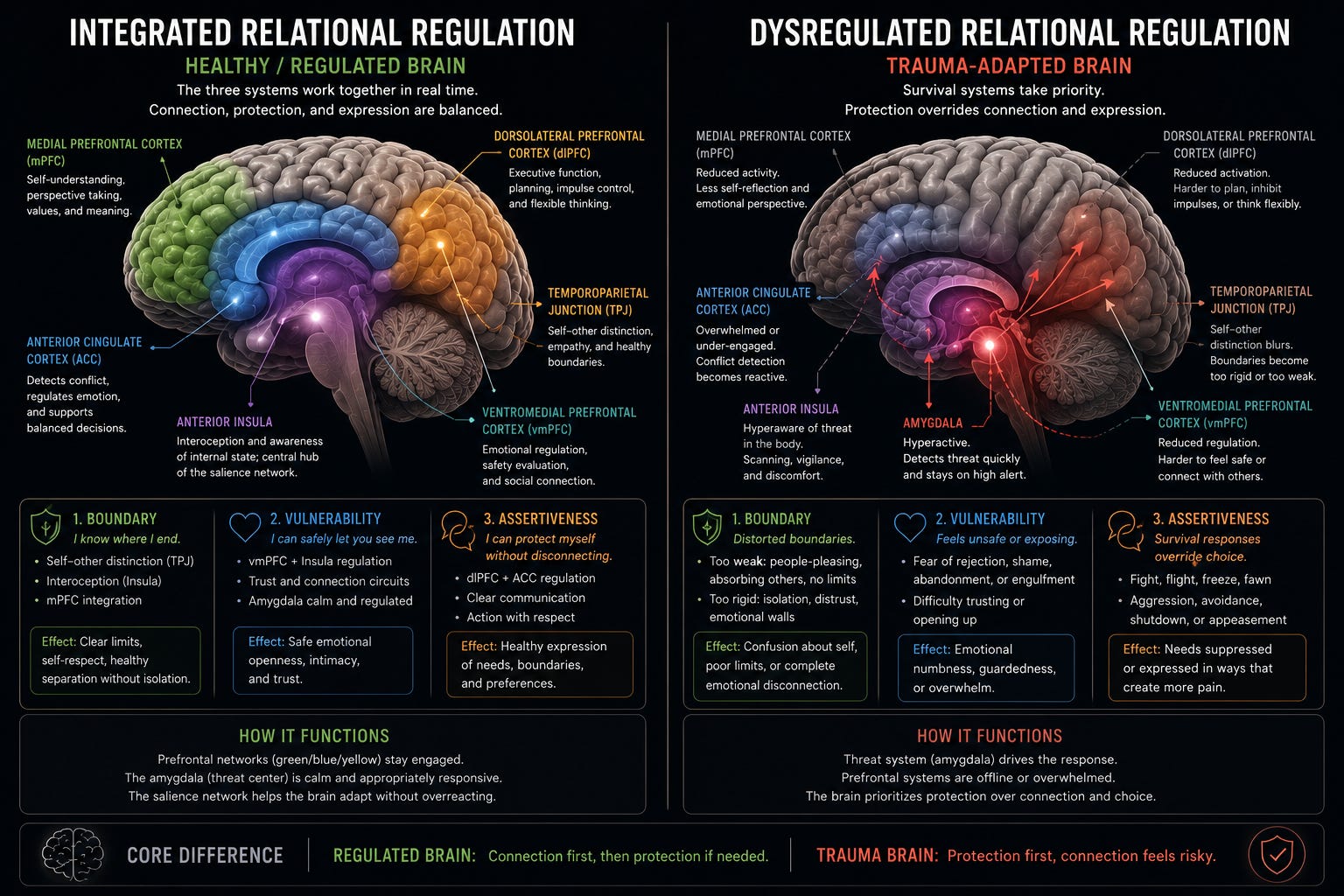
On the right side of the image, however, you can see what begins happening when trauma takes over the system. The amygdala becomes hyperactive, the brain starts scanning for threat instead of connection, and the prefrontal regions responsible for regulation begin losing influence. Self-other distinction becomes blurred, emotional openness starts feeling unsafe, and survival responses like fight, flight, freeze, or fawn begin overriding calm communication.
At that point, the conversation is no longer just being experienced socially. It is being experienced biologically. The nervous system starts prioritizing protection over connection, often long before the conscious mind fully understands why the body suddenly feels unsafe. An uncomfortable need to protect yourself starts to shift the physical feelings in the body from focusing on the conversation at hand to surviving the experience.
Physical feelings start pulling you away.
Connection First vs Protection First
A normal regulated nervous system usually leads with connection first and protection second, only when it is needed. We are, by nature, social beings that want to make meaningful connections with others. Under normal conditions, a healthy nervous system assumes connections are generally safe. It allows the prefrontal cortex to stay active in processing daily interactions in an open and curious way. This allows us to continue being a social part of society. You can often see this in most young children who want to go and talk to everyone… even when their parents are trying to teach them ‘stranger danger.’
However, a trauma-adapted nervous system often reverses that order. When a person has been changed by experiencing a traumatic experience, their mind subconsciously changes its priorities. The brain starts using past experiences to predict future outcomes as if there is an imminent need for survival. Curiousity is replaced with threat detection. In this state, the mind will seek protection first, and connection only follows if the nervous system decides it is safe enough.
This is why trauma responses often feel automatic and uncontrollable. When a person’s amygdala starts becoming more vigilant, the mind focuses on reacting to threats instead of being open and attentive to the conversation. That single shift in where the brain processes current events changes almost everything about how someone experiences relationships. The person may still want closeness and companionship. However, the nervous system no longer treats openness as neutral. Instead, stress hormones start activating, and the body starts scanning for danger. Will this hurt me? Will this overwhelm me? Will this cost me a friendship?
Will this make me unsafe?
This is why trauma feels so confusing from the inside. As seen in the National Library of Medicine, the prefrontal cortex becomes less dominant when you are under emotional stress. You may consciously want connection while your body reacts to closeness as if it carries risk. This subconscious change in how the brain processes life events will take the lead and choose to avoid anything that gives the impression of causing discomfort.
What becomes important here is understanding that healing is not simply about becoming “more open” or “less defensive.” A person cannot force themselves into a healthy connection while their nervous system still believes connection is dangerous. Before someone can build healthy boundaries, practice vulnerability, or become more assertive, the nervous system first has to begin separating real present-day danger from old survival patterns.
That is where Integrated Relational Regulation starts becoming practical instead of theoretical. These deeply connected ways direct the nervous system to manage relationships, emotional safety, and self-protection. When one of these becomes distorted from learning to react to a traumatic experience, the others usually shift with it. A person with weak boundaries may struggle with vulnerability because they fear emotional overwhelm. A person with rigid boundaries may struggle with assertiveness because they learned that emotional withdrawal feels safer than direct expression.
The goal is not perfection. The goal is to find balance again. Healthy relational regulation happens when someone can remain emotionally connected without losing themselves, emotionally open without feeling exposed, and emotionally direct without becoming aggressive or shutting down. That balance starts with understanding what healthy boundaries actually are.
Interpersonal Boundaries Are Not Walls
Most people think boundaries are walls, distance, coldness, or detachment. In a lot of conversations, boundaries are treated as if they are simply about keeping people away from you. Healthy interpersonal boundaries are actually quite the opposite. They are what make a safe connection possible in the first place.
From a research perspective, the idea of interpersonal boundaries overlaps with several different psychological concepts. One is called the self-other distinction. Frontiers Psychiatry states that the self-other distinction is the ability to separate your own thoughts, emotions, experiences, and responsibilities from someone else’s. Without this ability, you can not hold a positive barrier between you (physically and mentally) from other people’s thoughts and actions.
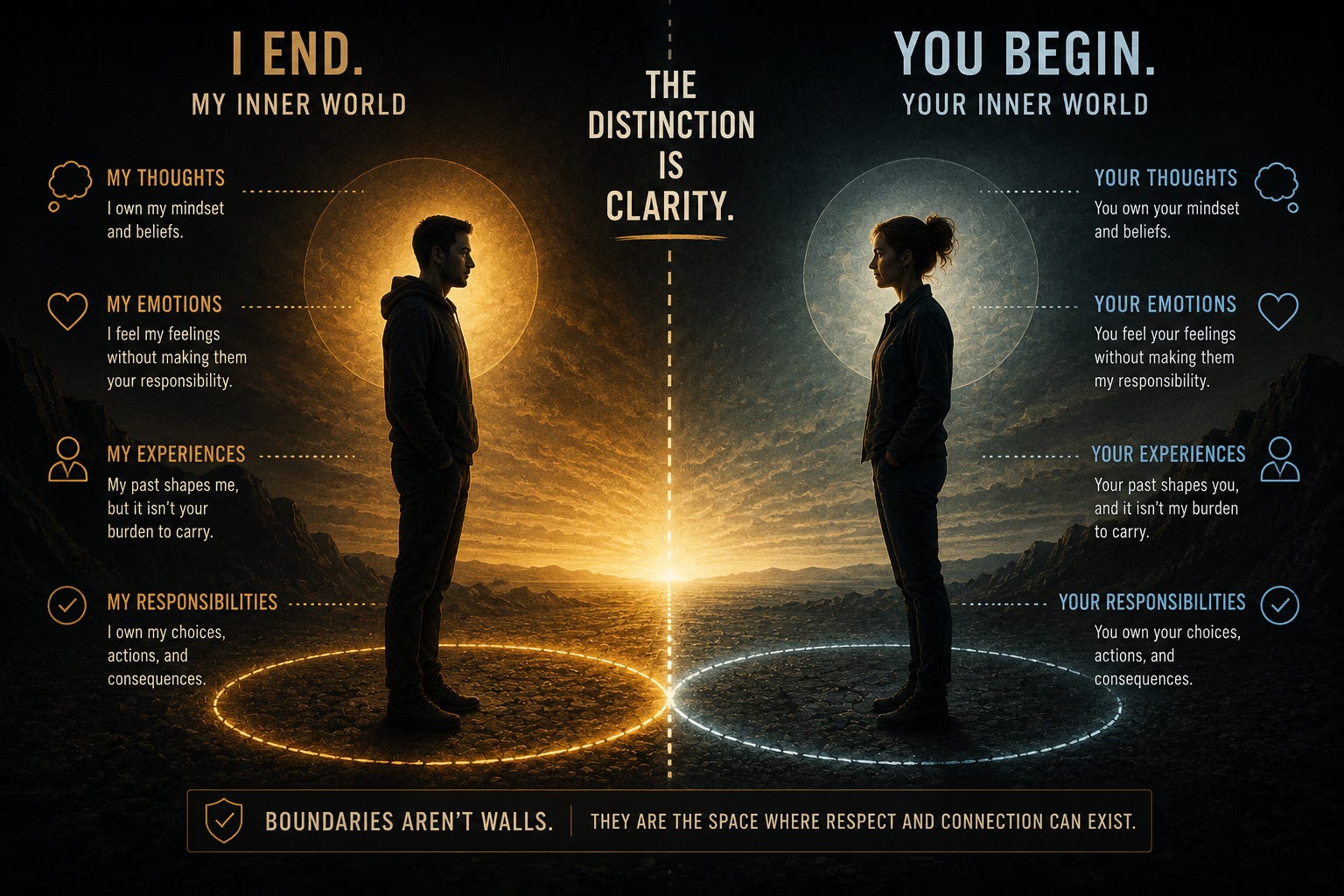
Next is differentiation of self, a concept from Bowen family systems theory that describes the ability to stay emotionally connected to other people without losing one’s own identity, values, or emotional stability in the process. If you have a weak differentiation, you will easily let others’ opinions and beliefs overpower your own. The third area is interpersonal limits, which focuses on understanding what is emotionally acceptable, what is not, and being able to communicate those limits clearly.
Even though these research areas use different terminology, they all seem to point toward the same deeper function. A healthy boundary helps a person stay emotionally connected to others without emotionally merging with them. It creates enough separation for someone to recognize, “This is my feeling, and that is your feeling. This is my responsibility, and that is not my responsibility. This hurts me. This matters to me.”
This is where I end… and you begin.
When someone grows up in an emotionally unpredictable environment, those boundaries often become distorted. Some people lose themselves in everyone around them. They absorb emotions, over-explain, people-please, and constantly monitor the emotional state of others because their nervous system learned that staying emotionally connected reduced danger.
Other people move in the opposite direction. Their boundaries become rigid. Trauma causes them to seek safety first before connection. They isolate, distrust, detach, and become hyper-independent because their nervous system learned that closeness itself could become dangerous.
Both are attempts at safety using different approaches. Healthy boundaries exist somewhere in the middle. They allow us to care without carrying, listen without absorbing, and protect ourselves without emotionally disappearing. A healthy boundary is not a rejection of connection. It is the structure that allows connection to happen without self-abandonment.
Why Vulnerability Feels Dangerous
Vulnerability is one of the most misunderstood ideas in modern culture. Most people hear the word and immediately picture emotional flooding, oversharing, weakness, or exposing every wound to every person around them. But the more I have researched vulnerability, attachment theory, and emotional disclosure, the more I think healthy vulnerability is something much more regulated and intentional than that. It overlaps heavily with emotional disclosure, attachment security, and perceived social support.
Emotional disclosure refers to sharing emotionally meaningful information with another person, while attachment research focuses on whether the nervous system experiences relationships as safe, responsive, and emotionally predictable. As humans, we are looking for ways to emotionally disclose information that will add to a relationship without harming us. The less dangerous a situation feels to us, the more open we are to becoming emotionally vulnerable.
Research on perceived social support also shows that people become more emotionally open when they believe support is actually available and emotionally safe to receive. Vulnerability is not just about whether someone is willing to open up. It is also about whether their nervous system believes the relationship can safely hold what they are sharing.
Healthy vulnerability is not emotional exposure without limits. It is regulated emotional openness inside a relationship or environment where connection feels safe enough to risk being seen. It must happen in a situation where our brain is able to properly understand and communicate the desired emotions. If, however, past experiences have shown emotional vulnerability as painful and dangerous, the brain will quickly close this vulnerability to protect itself in a survival mode.
For a regulated nervous system, vulnerability often creates closeness. Research on self-disclosure consistently shows that reciprocal emotional openness helps build trust, emotional intimacy, perceived support, and stronger relational bonds (https://www.tandfonline.com/doi/full/10.1080/0144929X.2025.2590096). But for a trauma-adapted nervous system, vulnerability often feels more like exposure. The body may interpret emotional visibility as danger long before the conscious mind understands why.

This is one of the reasons trauma can become so isolating. A person may desperately want closeness while simultaneously feeling unsafe being emotionally visible. Research on attachment and emotional regulation shows that when people grow up experiencing emotional inconsistency, rejection, or unpredictability, the nervous system often learns to associate openness with emotional risk (https://pmc.ncbi.nlm.nih.gov/articles/PMC10849076/). In everyday life, this can show up as difficulty opening up emotionally, fear of rejection, needing constant reassurance, avoiding emotional closeness, or feeling unsafe being fully seen by other people.
That risk can take many forms. “If I say how I really feel, I may get rejected.” “If I need support, I may become a burden.” “If I let someone see this part of me, I may lose respect, safety, control, or connection.” Each one seeks avoidance over vulnerability.
The body learns these patterns long before we consciously recognize them. This is especially true for men. A lot of men are not taught vulnerability as emotional safety. They are taught that vulnerability risks strength, status, stability, control, or respect. So instead of emotional openness, many men learn performance via competence, humor, and stoicism. As a last resort, withdrawal can be used to escape emotional vulnerability. Not because they do not feel deeply, but because the nervous system has learned that emotional visibility might not be safe.
Research on emotional avoidance and attachment avoidance supports this idea as well. Studies have shown that individuals who fear dependency or emotional rejection often rely on emotional suppression and avoidance instead of healthy disclosure (https://www.sciencedirect.com/science/article/abs/pii/S0191886914003997). The nervous system is still trying to protect the person. It is just using distance instead of openness.
Vulnerability is not really the absence of protection. It is the ability to remain emotionally visible without the nervous system collapsing into fear. A normal individual will learn the skills needed to be vulnerable when appropriate. A person who has unresolved trauma will take opportunities to avoid vulnerability whenever possible.
Assertiveness Is Not Aggression
The third part of this framework is assertiveness, and honestly, I think this may be the most misunderstood of the three. Most people confuse assertiveness with aggression because both involve direct expression. But they are not the same thing at all.

Aggression protects through force.
Assertiveness protects through clarity.
From a research perspective, assertiveness is closely connected to emotional regulation, communication skills, interpersonal functioning, and self-respect. Assertiveness training has even been studied as an evidence-based treatment approach for anxiety, depression, unresolved anger, social anxiety, and interpersonal difficulties because many people never actually learn how to express themselves in a healthy and regulated way.
Social media, while intended to connect us, has taught us aggression, leading to isolation. This has dominated our lives for the last decade. One look at X and you can quickly see the devicive nature of social media. Assertiveness training now can show us a way back to the community we were truly looking for. It can show us how to effectively show our thoughts, opinions, and beliefs while still respecting others.
Healthy emotional assertiveness means being able to express what you feel, need, believe, or prefer clearly and respectfully without becoming passive, aggressive, avoidant, or emotionally overwhelmed. In practical terms, it means being able to calmly say: “I am not okay with that.” “I disagree.” “I need space.” “That hurt me.” “No.” It allows you to respectfully state your opinion without feeling like your entire sense of safety, identity, or connection is suddenly under threat.
That is harder than most people realize. A lot of people are not actually afraid of speaking. They are afraid of what speaking might cost them. For some people, assertiveness feels dangerous because they learned that emotional expression led to conflict, punishment, rejection, humiliation, abandonment, or escalation. Their nervous system learned that silence felt safer than honesty. For me, any form of emotional expression would draw attention to me in a negative way. Growing up in a town where racism was unchecked, this led to danger for anyone with skin that was just a little too dark.
Others learned that the only way to be heard was through aggression because calm communication was ignored. Over time, their nervous system stopped seeing assertiveness as effective. Calmness started to feel powerless. Respectful communication started to feel invisible. If speaking softly never protected them, and direct communication was constantly dismissed, interrupted, mocked, or overpowered, then aggression eventually became associated with survival.
Unfortunately, this is the path that my youth took me. I went from being unnoticed for the most part to realizing that you cannot completely disappear from racism. At this point, I chose to feed off the anger and rage that was building inside of me. My aggression quickly taught me that it was better to be feared than taken advantage of. The problem is that while aggression may create short-term control, it often damages the very relationships and emotional safety of the people you are ultimately trying to protect. Aggression has a way of changing a person, and that can affect people whom you are not trying to show your aggression towards.
This is where trauma changes the system again.
Healthy assertiveness requires emotional regulation. A person has to stay present enough to know what they feel, what they need, and what they are trying to communicate without the nervous system collapsing into survival mode. When trauma is activated, the nervous system may rapidly shift into fight, flight, freeze, or fawn responses. Instead of calm expression, people often shut down, over-explain, emotionally detach, avoid conflict, become reactive, or silently build resentment.
This happens because the nervous system takes past experiences and uses them to start predicting danger around expression. Research on assertiveness training supports this idea as well. Studies have shown that assertiveness is not simply a personality trait someone either has or does not have. It is a skill connected to emotional regulation, communication, confidence, and interpersonal safety that can be developed over time (https://www.stonybrook.edu/commcms/psychology/_pdfs/faculty/Speed_et_al-2017-Clinical_Psychology__Science_and_Practice.pdf).
The more I think about this, the more I believe emotional assertiveness is where interpersonal boundaries and vulnerability finally become action. Interpersonal boundaries help us understand where we end. Vulnerability allows us to acknowledge what is emotionally true in an effort to connect at a deeper level. Assertiveness is the moment we communicate those truths without attacking, collapsing, over-explaining, or abandoning ourselves in the process.
What Healing Might Actually Be

Healing may not be about becoming less emotional. It may not even be about becoming more confident. Maybe healing is about helping these three systems work together again. It’s about looking at the patterns and habits you created along the way in pursuit of a more connected life.
A healthy nervous system can move fluidly between interpersonal boundaries, vulnerability, and assertiveness. It can stay open without collapsing, protected without shutting down, and direct without becoming harmful. That is integration. Not perfection. Integration that can be practiced, thought about, and refined. Over time, it will become easier and more effective.
Emotional struggle is not about weakness or failure. It is about a nervous system that adapted to survive environments where openness did not feel safe. You can see the actions and emotions that once protected you, but no longer serve your current needs. It’s time to start working on these habits to refocus on where you are now and who you want to become. A healthy nervous system is attainable if you are willing to work for it.
The goal is not to become fearless. The goal is to become regulated enough that fear no longer has to run everything. The nervous system does not heal through force. It heals through repetition, safety, repair, and experiences that slowly teach the body that connection and protection do not have to be enemies anymore.
That is what emotional health actually is.
Not softness. Not hardness.
Integration.